TrainAR - The Basic Concepts
Get a quick introduction to TrainAR and how to create a training in this 90-second video, then read on for the basic concepts behind the authoring tool.
The TrainAR Authoring Tool can be utilized by understanding two basic concepts: The TrainAR Object and the TrainAR Stateflow. If you want to create a TrainAR scenario/training, you have to import 3D models (e.g. from the Assetstore, external websites or from a 3D scanner) and then convert them into TrainAR Objects. Once converted, they automatically inherit TrainAR-specific functionality/behaviours and states (position, rotation, scale, visibility, grabbability, interactability, combinability). TrainAR objects can then be referenced in the TrainAR Stateflow, which determines what action has to be taken next by the user of the TrainAR training and which kind of instruction, insight or feedback should be provided to the user. It additionally can manipulate states of TrainAR Objects during the training.
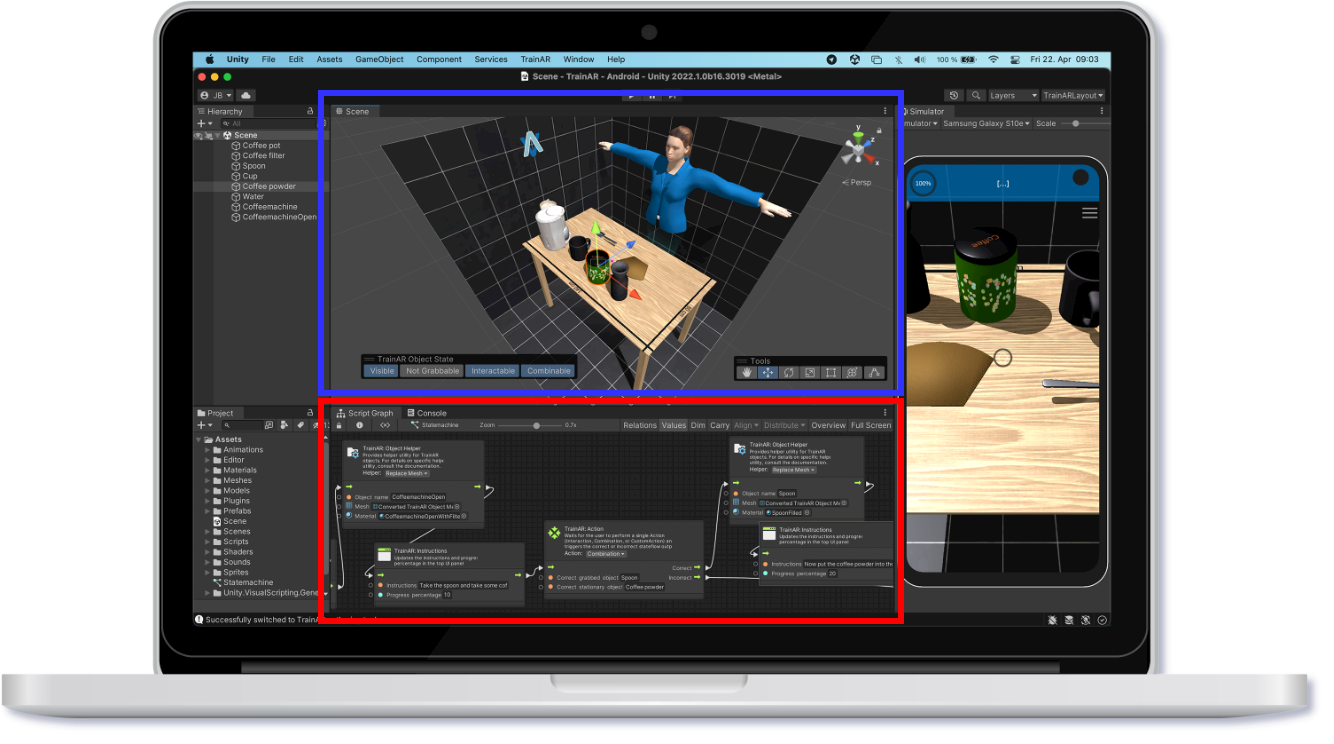
As visualized in this figure, the TrainAR Authoring Tool provides an abstraction layer to easily access both. In blue is the Scene showing all TrainAR Objects currently in the training assembly. Here, their initial state can be manipulated (e.g. they can be positioned, rotated, they can prohibit being grabbed and be invisible at the start of the training). In Red is the TrainAR stateflow, where the flow of the training can be created and altered. The TrainAR Objects and TrainAR Stateflow can be connected by referencing TrainAR Objects in the TrainAR Stateflow by name. In green is the TrainAR Trainings tab: one project can hold several trainings, each with its own TrainAR Objects and TrainAR Stateflow, and here they are opened, created and managed (see Managing Trainings).
The rest is handled by the framework. Features like the onboarding animations, tracking solutions, assembly placement, interaction concepts, layered feedback modalities, expert insights, state management and training assessments are taken care of automatically. Notably, they can also be altered and expanded upon as described in the Advanced Options, if necessary. To provide a reference on what is possible with TrainAR, the following showreel shows 5 exemplary TrainAR trainings and games that were developed with TrainAR and evaluated by researchers at University of Applied Sciences Emden/Leer, KU Leuven, and Utrecht University:
The following reference video shows the coffee example training shipped with the repository. On the left, the deployed TrainAR training is shown from the perspective of the user that is using the training and trying to interact with TrainAR Objects. On the right, the TrainAR Stateflow from the perspective of the author is visualized that determines the training procedure:
TrainAR Documentation
 |
 |
| Coffee: brew a pot of filter coffee. Everyone knows how to make coffee, so you can focus on how TrainAR works. (reference video on YouTube) | Four-Stroke Engine: assemble one cylinder of a four-stroke engine part by part and start it, while the expert explains every part and questions check what you understood. (reference video on YouTube) |
The TrainAR framework ships with these two example trainings, "preparing a coffee by using a coffee machine" and "assembling a four-stroke engine", to provide a basic point of reference and starting point to authors (see Managing Trainings). Beyond that, the documentation provides an Installation & Setup Guide and a Getting Started Guide that explains how to create a very basic, first training scenario in less than half an hour from scratch. Furthermore, a full documentation on TrainAR Objects and the TrainAR Stateflow with all its TrainAR Visual Scripting Nodes is provided. Finally, if experienced authors want to utilize TrainAR beyond the envisioned scope, there is multiple levels of advanced options that provide more powerful customization options to authors as described in the Advanced Options.